



Variable Frequency Drive Water Pump: Full Guide
What Is a Variable Frequency Drive Water Pump?
A variable frequency drive water pump is a pumping system in which the motor speed is continuously adjusted by a variable frequency drive (VFD) — an electronic controller that modifies the AC power frequency supplied to the motor. Rather than running at a fixed speed regardless of demand, the pump accelerates or decelerates in real time to match the actual flow requirement of the system. This one capability fundamentally changes how water pressure is maintained and how much energy the system consumes.
In a conventional fixed-speed pump setup, pressure is regulated by throttling valves or by switching pumps on and off. Both methods waste energy and introduce pressure fluctuations. A VFD pump eliminates those compromises: the drive monitors system pressure through a pressure transducer and continuously feeds that signal back to a microcomputer controller, which recalculates the required motor speed several times per second. The result is a system that is always running at precisely the speed needed — nothing more, nothing less.
Because pump power consumption follows the affinity laws, even a modest speed reduction yields a disproportionately large energy saving. Reducing pump speed by just 20% theoretically cuts power consumption by nearly 50%. In practice, real-world savings in commercial and industrial installations typically range from 30% to 60% compared with equivalent fixed-speed systems, making the VFD one of the most cost-effective upgrades available in fluid handling.
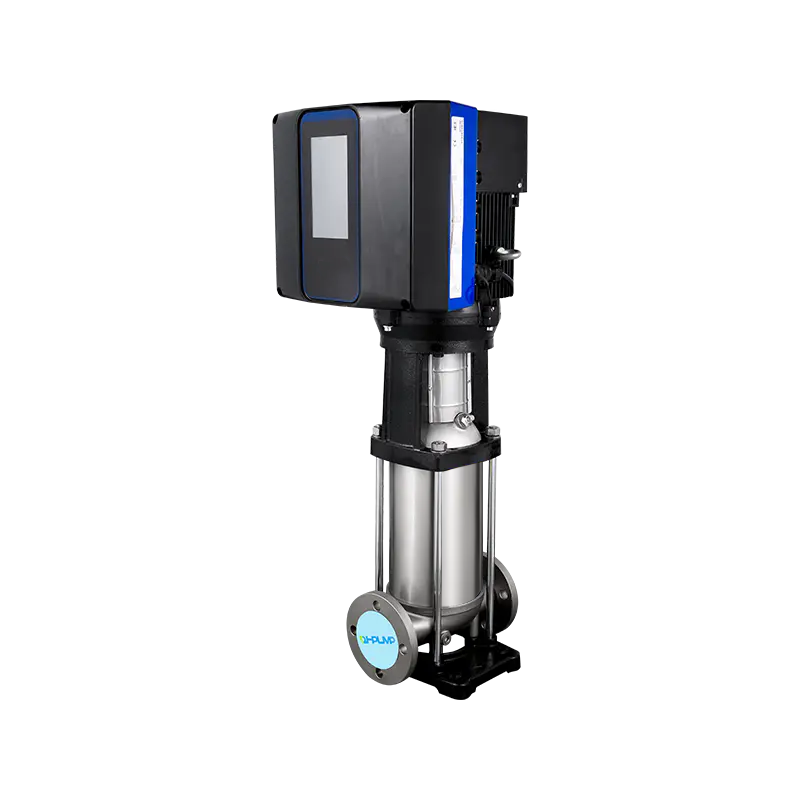
How Intelligent Variable Frequency Water Supply Equipment Works
Intelligent variable frequency water supply equipment takes the core VFD concept and wraps it in a complete, self-contained package: drive, controller, pressure sensors, protection circuits, and a stainless-steel pump group, all pre-engineered and factory-tested. The operating logic is built around a closed-loop PID (proportional-integral-derivative) control algorithm running inside a microcomputer.
The Constant-Pressure Control Loop
The operator sets a target pressure — typically expressed in MPa or bar — at the control panel. A pressure transducer installed on the discharge manifold continuously measures actual system pressure and transmits that reading to the microcomputer. The controller compares the measured value against the setpoint and calculates the error. Based on the error and its rate of change, the PID algorithm outputs a frequency command to the VFD, which adjusts motor speed accordingly:
- When water demand rises — more taps open, a fire suppression system activates, or an industrial process draws higher flow — pressure starts to drop. The controller immediately increases drive frequency, raising pump speed to restore pressure.
- When demand falls — night hours in a residential complex, a process line goes idle — pressure tends to rise. The controller reduces drive frequency, slowing the pump and trimming energy use in proportion.
- In multi-pump configurations, the controller can also stage pumps in and out of service, running one pump at full VFD control while additional pumps start or stop on the basis of long-term demand trends.
This feedback loop repeats continuously, maintaining outlet pressure within a very tight band — typically ±0.01 MPa — regardless of fluctuations on either the supply or demand side.
Soft-Start and Ramp-Down Protection
Because the VFD controls motor acceleration and deceleration electronically, there is no mechanical contactor switching and no inrush current spike at startup. The motor ramps up smoothly over a configurable time — commonly 5 to 30 seconds — eliminating water hammer in the pipework and dramatically reducing mechanical stress on impellers, seals, and bearings. Extended equipment life and reduced maintenance intervals are direct consequences.
Key Features and Design Advantages
Modern variable frequency drive pump packages are engineered for rapid deployment and long-term reliability. Several design features distinguish them from older booster sets:
| Feature | Specification / Benefit |
|---|---|
| Pump and tank materials | 304 or 316 stainless steel — prevents corrosion and secondary water pollution |
| Footprint | Compact skid-mounted assembly; typically 40–60% smaller than equivalent traditional booster rooms |
| Installation | Pre-wired and pre-piped at the factory; site work limited to connecting inlet, outlet, power, and ground |
| Protection functions | Overload, short-circuit, phase-loss, overtemperature, dry-run, and overpressure — with automatic alarm and shutdown |
| Display and diagnostics | LCD or touchscreen panel showing real-time pressure, motor frequency, fault codes, and run history |
| Communication | Modbus RTU / RS-485 standard on most units; optional Ethernet, BACnet, or 4G remote monitoring |
The use of stainless steel throughout the water-contact path is particularly significant for potable water applications. Galvanized steel and cast iron tanks can leach metals and harbor biofilm over time. Stainless steel surfaces are inherently resistant to bacterial adhesion, meet food-grade hygiene standards, and require no internal coating that could crack or peel — a common source of secondary contamination in older pressure tanks.
Fault Protection and System Safety
One of the defining strengths of intelligent variable frequency water supply equipment is its comprehensive, layered protection architecture. Every unit monitors multiple parameters simultaneously and is programmed to respond to anomalies in a defined priority sequence — alert, reduce load, then shut down — rather than simply tripping the entire system at the first sign of a fault.
Critical protections built into the standard package include:
- Dry-run protection: A pressure or flow sensor detects when the suction source is exhausted. The controller stops the pump within seconds to prevent impeller damage from running without liquid. The system waits for a configurable recovery period before attempting an automatic restart.
- Overpressure protection: If system pressure exceeds the high-limit setpoint — due to a blocked outlet valve or sudden demand drop — the controller reduces pump speed and, if pressure continues to rise, initiates a controlled shutdown and triggers an alarm.
- Phase-loss and phase-imbalance detection: Three-phase power anomalies are detected within milliseconds. The system halts before motor windings sustain thermal damage, a common and expensive failure mode in fixed-speed pump stations.
- Overtemperature protection: Thermal sensors on both the VFD heat sink and motor windings trigger a warning at a first threshold and a shutdown at a second, allowing the operator to investigate before permanent damage occurs.
- Automatic fault logging: The microcomputer records the time, fault type, and operating parameters at the moment of each event. This log is invaluable for diagnosing recurring issues and for planning preventive maintenance schedules.
In multi-pump installations, a lead-lag rotation function distributes run-hours evenly across all pumps in the group, preventing a situation where one unit accumulates the majority of service hours while others sit on standby. Even wear extends seal and bearing life across the entire asset fleet.
Typical Applications Across Industries
The versatility of the variable frequency drive pump platform means a single product family can serve a wide range of constant-pressure water supply requirements. The common thread across all applications is the need to deliver a stable outlet pressure despite continuously changing demand — exactly what VFD control handles best.
Municipal and Water Treatment Infrastructure
Water treatment plants and booster pump stations must handle demand swings that can exceed 5:1 between peak morning usage and nighttime minimum flow. Fixed-speed pumps operating at this duty point waste enormous energy during off-peak hours. VFD-controlled booster sets match the actual distribution demand in real time, reducing energy costs while keeping network pressure within the tight bands required to prevent both pipe bursts at high pressure and contamination ingress at low pressure.
Residential Complexes and High-Rise Buildings
In high-rise residential towers and large apartment complexes, the pressure differential between the lowest and highest floors can exceed 0.5 MPa. Zoned VFD booster systems are installed on each pressure zone, maintaining consistent pressure at every floor irrespective of simultaneous usage across the building. Occupant complaints about weak showers on upper floors — a near-universal problem with fixed-pressure systems — are eliminated. Hotels and large public buildings benefit in the same way, with the added advantage of quieter operation because soft-start eliminates the banging and vibration associated with direct-on-line pump switching.
Industrial and Mining Applications
Industrial processes — cooling circuits, washdown systems, boiler feedwater supply, and process water lines in manufacturing plants — demand highly consistent pressure to protect sensitive equipment and maintain product quality. Mining operations require robust water supply for dust suppression, ore processing, and equipment cooling, often in remote locations where power quality is inconsistent. The protection functions built into intelligent variable frequency drive water pump packages — phase-loss detection, overtemperature shutdown, and automatic restart after supply restoration — make them well suited to these demanding environments.
Selecting the Right Variable Frequency Drive Pump System
Choosing the correct intelligent variable frequency water supply equipment for a project requires evaluating several interdependent parameters. Getting the sizing right at the design stage avoids both under-performance and the energy penalty of running an oversized pump at partial load with a throttled VFD output.
The primary selection criteria are:
- Peak flow rate (Q): Calculated from the maximum simultaneous demand across all consumption points, expressed in m³/h or L/s. Size the pump group to meet peak demand at rated speed; the VFD then reduces speed for partial loads.
- Required head (H): The sum of static head (height from source to the highest outlet), friction losses through pipework, and the minimum residual pressure needed at the furthest point of use. This figure determines the pump curve and motor power rating.
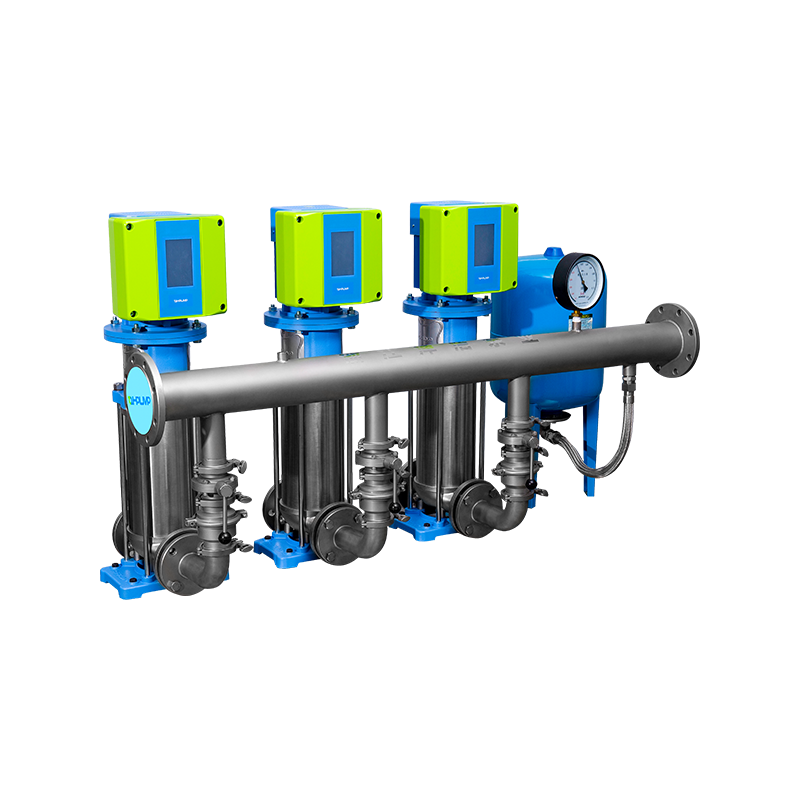
- Number of pumps: Single-pump units suit small buildings and light industrial loads. Multi-pump parallel configurations — typically two to five units — provide redundancy and finer capacity increments, allowing the controller to stage pumps in and out rather than running one pump at very low speed.
- Water quality and material selection: Standard 304 stainless steel is appropriate for most potable water applications. Chlorinated or saline process water may require 316L stainless or specialist alloy impellers.
- Communication and monitoring requirements: Projects with building management systems (BMS) or SCADA integration should specify units with compatible fieldbus options from the outset, as retrofitting communication hardware is significantly more expensive than ordering it factory-fitted.
Once a system is commissioned, the investment in an intelligent variable frequency drive water pump solution pays back through lower electricity bills, reduced maintenance expenditure, longer equipment life, and — critically — the assurance of reliable, constant-pressure water supply that end users never have to think about.
หมวดหมู่ผลิตภัณฑ์
บทความที่แนะนำ
ปั๊มแรงเหวี่ยงหลายขั้นตอนในแนวตั้ง: คู่มือที่สมบูรณ์สำหรับการเลือกการติดตั้งและประสิทธิภาพ
คำแนะนำที่ดีที่สุดสำหรับปั๊มน้ำเสีย: submersible กับการระบายน้ำ
ปั๊มน้ำเสียมีบทบาทสำคัญในระบบการจัดการน้ำเสียสมัยใหม่ ไม่ว่าจะอยู่ในที่อยู่อาศัย comm ...
ปั๊มแรงเหวี่ยงและหลายขั้นตอน: คู่มือที่ครอบคลุม
ปั๊มมีบทบาทสำคัญในการเคลื่อนย้ายของเหลวในแอพพลิเคชั่นต่าง ๆ ตั้งแต่ระบบน้ำประปาไปจนถึงฉัน ...

ผลิตภัณฑ์ที่แนะนำ
มันมุ่งเน้นไปที่การแก้ปัญหาโดยรวมของระบบการถ่ายโอนพอร์ตวัสดุจำนวนมาก
การวิจัยและพัฒนาการผลิตและบริการ

 ภาษาอังกฤษ
-
 พื้นที่โรงงาน 5-6, หมายเลข 1118 Xin'an Road, Nanxun Town, Huzhou City, Zhejiang Province
-
 +86-4008117388
-
 [email protected]
ลิขสิทธิ์© Zhejiang Zehao Pump Industry Co. , Ltd. สงวนลิขสิทธิ์

